
Hump Nose Correction in Korea
Smooth a prominent dorsal hump and support the tip for a softer, younger-looking profile.
A smoother line, a softer impression
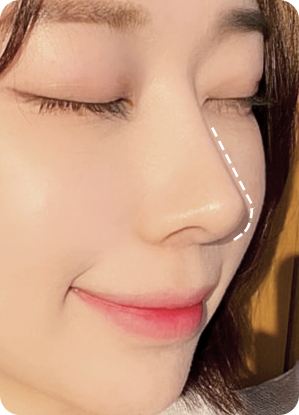
Hump nose correction removes a dorsal hump formed by protruding nasal bone and cartilage. At YUNO the technique depends on severity: a mild hump is rasped down, a hump with a wide bridge also needs osteotomy, and a hump with a drooping tip is combined with tip support using autologous cartilage.
A hump can make the face look strong, older or longer than it is, especially when the tip also droops. Removing the hump alone is not always enough; the bridge width and tip support must be balanced too, or the nose can look flat or wide afterwards.
Good candidates
- A bridge that protrudes in the middle
- A bridge that looks uneven from the front or side
- A hump plus drooping tip that makes the face look long
- A bridge that sits higher than the tip
- A nose shape changed by an injury
Why the cause matters
Hump, wide bridge and drooping tip often appear together. Treating only one leaves the others more visible, so the plan is based on which combination you have.
How the surgery is tailored
Mild hump
The protruding bone and cartilage are rasped smooth. If needed, silicone and autologous tissue refine the overall shape.
Hump with a wide bridge
After the hump is reduced, nasal bone osteotomy narrows the bridge. Implant or cartilage may be added for the desired height.
Hump, wide bridge and drooping tip
Septal or rib cartilage builds a strong tip column that lifts the drooping tip while the bridge is reshaped.
Implants & autologous tissue
The right material depends on your skin, the condition of your nose and the shape you want. Your surgeon will explain the options at consultation.
| Material | Type | Typical use |
|---|---|---|
| Silicone | Implant | Raises the bridge and creates a smooth line |
| Gore-Tex | Implant | Porous surface lets tissue grow in for close adhesion |
| AlloDerm | Processed human dermis | Covers thin skin over the bridge or adds tip height |
| Ear cartilage | Autologous | Tip shaping and lengthening |
| Septal cartilage | Autologous | Tip projection and nose lengthening |
| Rib cartilage | Autologous | Strong support with ample volume, often for revision |
| Dermis & fascia | Autologous | Soft-tissue padding under thin skin, reduces implant show |
Hump Nose Correction information
Times are typical and vary with each case. As with any surgery, bleeding, infection or inflammation can occur, and the degree differs between individuals. Your surgeon will explain risks and aftercare in detail.
Hump Nose Correction: questions
Is the hump removed by shaving or by breaking the bone?
Mild humps are rasped smooth. If the bridge is also wide, osteotomy is performed to narrow it after hump removal. The method depends on your 3D-CT findings.
Will my nose look flat after hump removal?
Not if the plan balances height. When needed, a small implant or cartilage restores a smooth bridge line after the hump is reduced.
Can a drooping tip be corrected at the same time?
Yes. Autologous cartilage such as septal or rib cartilage is used to support and lift the tip in the same operation.
How long is the recovery?
Most patients recover within about a week, with stitches removed after 5 to 7 days. Swelling continues to settle over the following weeks.
Explore more
Rebirth Rhinoplasty
Our signature design for a nose that suits every angle.
Read moreLong & Arrow Nose
Shorten the nose and lift a drooping tip.
Read moreCrooked Nose Correction
Straighten bone and septum, improve breathing.
Read moreWide Nose Reduction
Narrow a broad bridge with osteotomy.
Read moreSend your photos, get an honest opinion
Share front and side photos on WhatsApp or KakaoTalk. A board-certified plastic surgeon will review your nose and suggest only what you need.