
Low Nose Augmentation in Korea
Add height to a flat bridge and dimension to the tip, so your features look clearer and your profile more defined.
From flat to three-dimensional
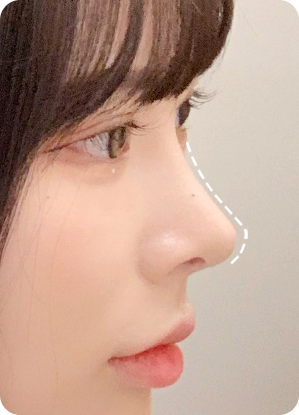
Low nose augmentation (augmentation rhinoplasty) raises a nasal bridge and tip that are low for the proportions of the face. At YUNO the bridge is usually raised with a silicone implant, while the tip is projected with your own cartilage, for a natural line that brightens the whole face.
A low nose can make the face look flat, the eyes look further apart, and the side profile look plain. Because the bridge and tip are different structures, we treat them separately: an implant for a smooth bridge, autologous cartilage for a soft, natural tip.
Good candidates
- The whole nose is low, both bridge and tip
- A flat look you want to make more three-dimensional
- A low bridge that makes the eyes appear far apart
- A face that looks flat from the front
- A plain side profile lacking definition
Why the cause matters
Many patients with a low nose also have a short or under-projected tip. Raising only the bridge can make the tip look even smaller, so we assess both before deciding on the design.
How the surgery is tailored
Bridge augmentation
A silicone implant carved to your face raises the bridge and creates a smooth, continuous line.
Tip projection with autologous cartilage
Ear or septal cartilage adds volume and height to the tip, keeping it soft and natural to the touch.
Material matched to your skin
For thin skin, soft tissue such as dermis or fascia can be added to reduce implant visibility.
Implants & autologous tissue
The right material depends on your skin, the condition of your nose and the shape you want. Your surgeon will explain the options at consultation.
| Material | Type | Typical use |
|---|---|---|
| Silicone | Implant | Raises the bridge and creates a smooth line |
| Gore-Tex | Implant | Porous surface lets tissue grow in for close adhesion |
| AlloDerm | Processed human dermis | Covers thin skin over the bridge or adds tip height |
| Ear cartilage | Autologous | Tip shaping and lengthening |
| Septal cartilage | Autologous | Tip projection and nose lengthening |
| Rib cartilage | Autologous | Strong support with ample volume, often for revision |
| Dermis & fascia | Autologous | Soft-tissue padding under thin skin, reduces implant show |
Low Nose Augmentation information
Times are typical and vary with each case. As with any surgery, bleeding, infection or inflammation can occur, and the degree differs between individuals. Your surgeon will explain risks and aftercare in detail.
Low Nose Augmentation: questions
Which implant is used for a low nose?
The bridge is commonly raised with silicone, which creates a smooth line. Gore-Tex or AlloDerm may be considered in some cases. The tip is usually built with autologous cartilage. Your surgeon will recommend the best option for your skin and nose.
Will my nose look obviously done?
The aim is harmony. Height is chosen for your face, and the tip is shaped with your own cartilage so the result looks and feels natural.
How soon can I fly home?
Stitches are typically removed 5 to 7 days after surgery. Many patients fly home shortly after the first aftercare check, but your surgeon will confirm the right timing.
Can I combine low nose augmentation with alar reduction?
Yes. If wide nostrils make the nose look lower, alar reduction can be combined in the same surgery.
Explore more
Send your photos, get an honest opinion
Share front and side photos on WhatsApp or KakaoTalk. A board-certified plastic surgeon will review your nose and suggest only what you need.